The FWO-SBO project BIOSTABLE aimed to fundamentally improve our understanding and control of biological stability in drinking water systems. Ensuring microbiologically stable drinking water remains a major challenge for utilities, as microbial regrowth, pathogen invasion, and taste and odour issues continue to occur despite compliance with current standards.
BIOSTABLE addressed these challenges by integrating microbial ecology, analytical chemistry, advanced monitoring technologies, and modelling approaches into a unified framework for drinking water quality management.
Understanding biostability and invasion dynamics
A central objective of BIOSTABLE was to understand and quantify microbial regrowth and invasion potential in drinking water distribution systems. The project demonstrated that drinking water quality is not solely determined by bulk parameters, but by a complex interaction between:
- dissolved organic carbon (DOC) fractions,
- operational parameters and nutrients,
- disinfectants,
- and the resident microbial community.
Through controlled experiments and pilot-scale studies, the project identified key growth-limiting and growth-promoting factors, and defined conditions under which drinking water systems become either stable and resistant or susceptible to microbial disturbances.
A key insight was that microbial communities are not random but can form a “stable and resistant” community structure, which plays a critical role in preventing invasion by unwanted microorganisms.
Role of organic matter and treatment strategies
BIOSTABLE provided detailed insights into the role of organic matter composition and fractionation in driving microbial regrowth and water quality issues.
The project demonstrated that:
- specific DOC fractions are directly linked to microbial growth and taste & odour formation,
- removal of targeted organic fractions can significantly improve biological stability,
- and treatment strategies such as nanofiltration (NF) and ultrafiltration (UF) can influence both water composition and downstream microbial dynamics.
Importantly, the work highlighted the need to express and interpret organic carbon in absolute units (µg C/L) and to link chemical data with microbial measurements for meaningful system understanding.
Microbial community dynamics and biofilms
The project generated new knowledge on the interaction between bulk water communities and biofilms in distribution systems.
Pilot-scale experiments showed that:
- biofilm communities are relatively stable over time,
- while bulk water communities respond more rapidly to changes in source water or operational conditions,
- and bulk water can act as a seed bank for biofilm development.
These findings are crucial for understanding system resilience and for designing interventions that target both planktonic and surface-associated microbial populations.
Innovative monitoring and detection strategies
BIOSTABLE contributed significantly to the development of next-generation monitoring tools for drinking water systems.
The project highlighted the limitations of traditional cultivation-based methods, which detect only a very small fraction of the microbial community (e.g. ~0.03%) and often show poor correlation with actual system behaviour .
To overcome this, BIOSTABLE developed and validated:
- non-targeted flow cytometry fingerprinting for rapid detection of community-level disturbances,
- pre-enrichment strategies to detect low-abundance but relevant microorganisms,
- and third-generation sequencing approaches for targeted identification .
These tools enable early warning systems and more proactive water quality management.
Towards predictive and operational tools
Beyond experimental work, BIOSTABLE integrated its findings into predictive frameworks and digital tools. This includes:
- AI-based risk prediction models,
- development of a digital twin for biostability,
- and integrated mechanistic models for scenario analysis and treatment optimisation.
These developments provide a pathway towards data-driven decision-making in drinking water utilities.
Strong collaboration with water utilities
A key strength of BIOSTABLE was its close collaboration with drinking water companies. Case studies from utilities such as Pidpa, Water-link and Farys demonstrated how scientific insights can be directly translated into operational strategies.
The project addressed real-world challenges including:
- taste and odour events linked to organic compounds and disinfection by-products,
- the impact of pipe materials and network conditions,
- and the interpretation of microbial monitoring data in complex distribution systems.
The advisory board consistently highlighted the importance of translating results into practical tools for improving system stability and reliability.
Impact
BIOSTABLE has delivered a comprehensive framework for understanding and managing biological stability in drinking water systems. The project contributes to:
- improved prediction and control of microbial regrowth,
- more effective monitoring strategies,
- enhanced treatment optimisation,
- and increased reliability of drinking water quality.
By bridging fundamental science and practical implementation, BIOSTABLE supports the transition towards proactive and resilient drinking water management.
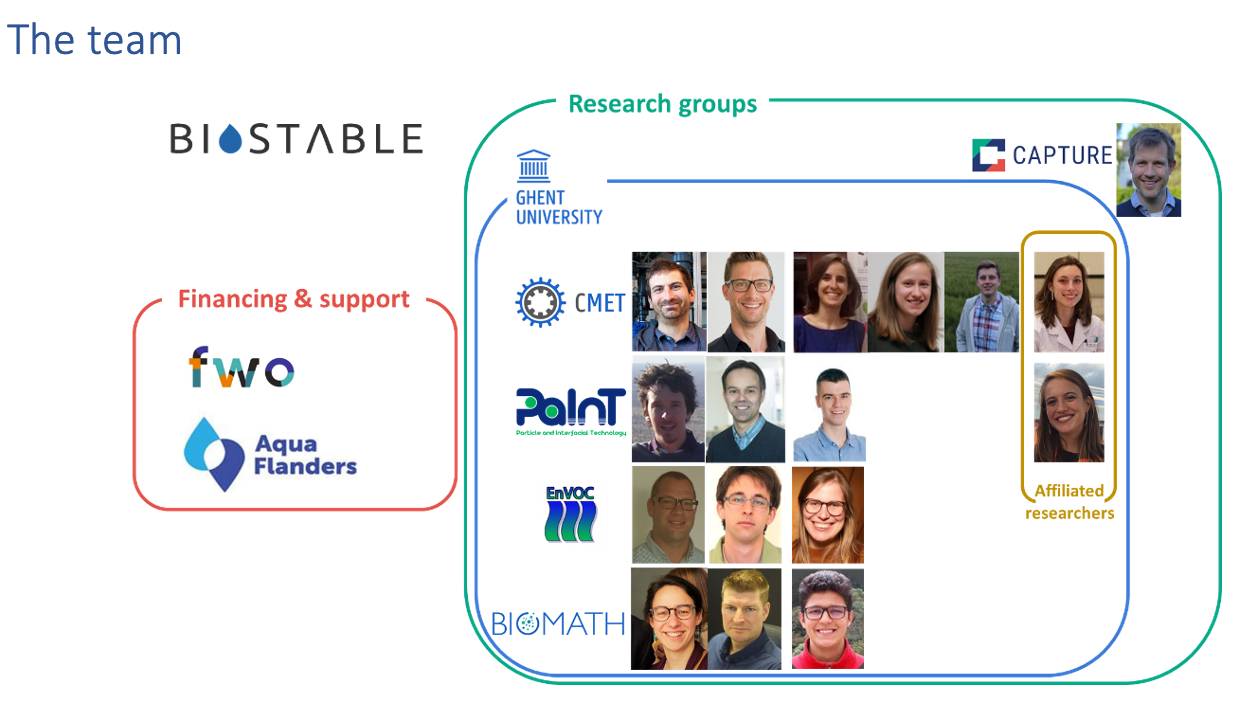
CMET
- Nico Boon (professor)
- Bart De Gusseme (professor)
- Cristina García-Timermans (postdoc)
- Fien Waegenaar (PhD student)
- Thomas Pluym (PhD student)
Paint
- Arne Verliefde (professor)
- Emile Cornelissen (professor)
- Cameron Dierendonck (PhD student)
EnVoc
- Kristof Demeestere (professor)
- Christophe Walgraeve (professor)
- Zöe Mol (PhD student)
Biomath:
- Elena Torfs (professor)
- Ingmar Nopens (professor)
- Cristian Camilo Gómez Cortés (PhD student)
- Saba Daneshgar (postdoc)
Affiliated researchers:
- Jorien Favere (PhD student, CMET)
- Karlien Dejaeger (PhD student, Paint)
CAPTURE:
- Jan Arends
Guaranteeing drinking water quality for citizens was uniformly assessed as an essential theme. This quality is influenced by physicochemical and microbial processes during storage and distribution of drinking water. After all, drinking water is not sterile and microbial regrowth and conversions of organic components in the water can lead to odour and taste complaints, damage to the pipe material and possible contamination with pathogens.
In striving for biostable drinking water without a negative quality change, BIOSTABLE aims to understand the influencing factors and to define unwanted changes. The most important dissolved and undissolved organic fractions in drinking water will be separated and defined. Subsequently, these fractions will be investigated which of them give the most cause for the formation of unwanted disinfection by-products that can give rise to undesirable quality changes in drinking water. BIOSTABLE will develop assays to quantitatively examine their potential for microbial regrowth and the effect of nutrient limitation and organic fractions.
The presence of unwanted organisms is analyzed today by detecting the so-called indicator organisms. An example of this is coliforms, however, not all coliforms are indicators of drinking water contamination. BIOSTABLE aims to make this distinction on a scientific basis and will define new quality indicators based on the latest developments in online microbial monitoring and molecular analyses. Finally, BIOSTABLE will use hydraulic models that make it possible to link the causes of quality changes to the structure of the distribution networks to map the risk areas.
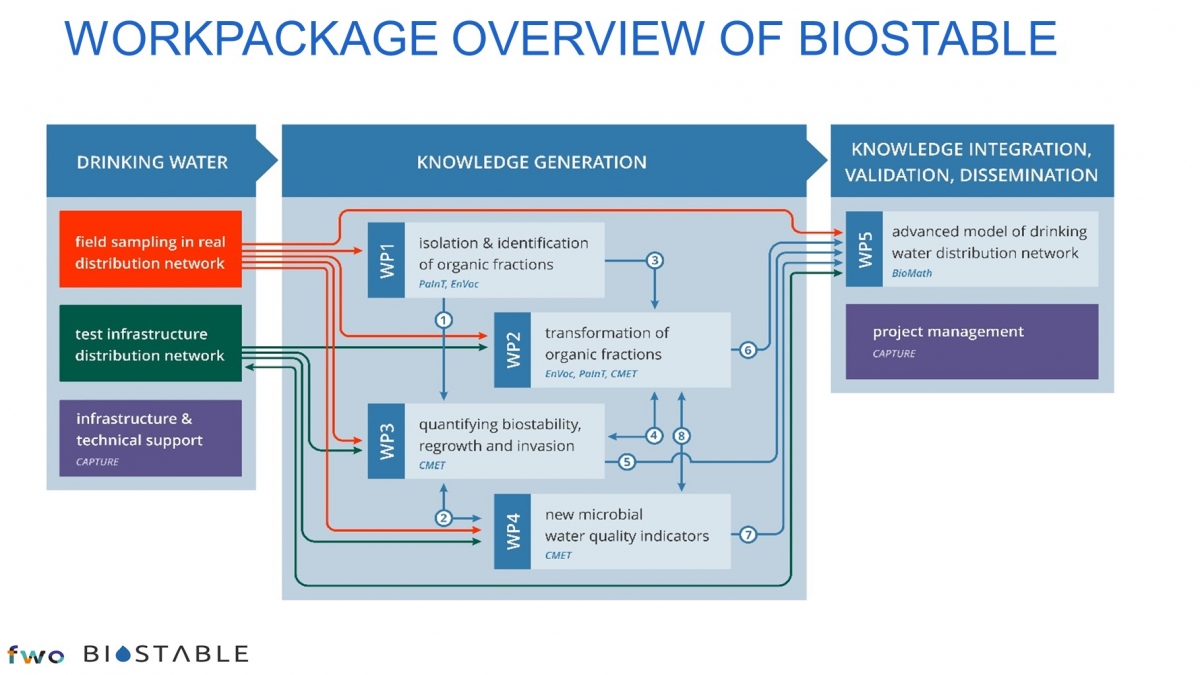
This research will lead to a better understanding of quality changes during distribution and to simulate the impact of changing the operational conditions on the stability of the water quality